Remotely Operated Vehicle (ROV) umbilical cables are the lifeline between a surface vessel and an underwater vehicle. They simultaneously transmit electrical power, control signals, video data, and — in hydraulic systems — pressurised fluid. Selecting the wrong umbilical type is one of the most costly mistakes in ROV system design. This guide covers every major umbilical type, their internal architecture, operational limits, and the decision framework engineers use to match the right cable to the right application.
Standard marine cables are designed to carry a single medium — power or signal — in a static or semi-static installation. An ROV umbilical must accomplish several tasks simultaneously while surviving continuous mechanical abuse: reeling and unreeling thousands of times, bending around tether management system (TMS) sheaves, twisting as the ROV changes heading, and flexing in strong currents at depths that can exceed 4,000 metres.
The defining characteristics that separate umbilicals from general marine cables are:
The electro-hydraulic umbilical is the traditional choice for work-class ROVs rated above approximately 50 horsepower. It combines electrical conductors for power and control with one or more hydraulic hoses that supply pressurised oil to the ROV's hydraulic power unit (HPU) and tooling circuits.
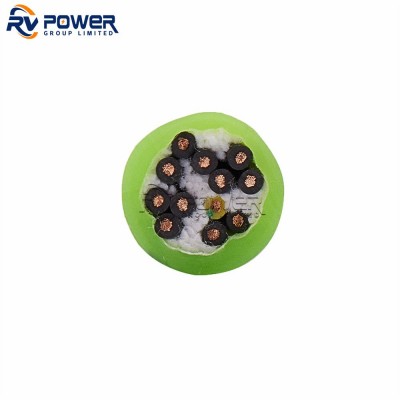
Internal construction (typical cross-section):
Depth rating: Standard EHUs are rated to 3,000 m. Deepwater variants with additional armour and pressure-compensated hydraulic design reach 6,000 m.
Typical diameter: 50–90 mm OD depending on hydraulic hose count and conductor size.
Key limitation: Hydraulic hoses are the stiffest component. They set the minimum bend radius and add significant weight, which must be managed by the LARS drum and tensioner. Hydraulic fluid leaks, while rare, create environmental compliance issues in sensitive areas.
The all-electric umbilical eliminates hydraulic hoses entirely. Power is delivered electrically at higher voltage (typically 3,000–6,600 V AC or 1,500–3,000 V DC), and all ROV thrusters and tools are driven by electric motors controlled by variable frequency drives (VFDs) within the ROV pressure vessel.
Internal construction (typical):
Advantages over EHU:
Key consideration: Higher voltage requires medium-voltage switchgear and transformer on the surface vessel, and ROV electronics must be designed for all-electric architecture. Retrofit of legacy hydraulic ROVs to AEU is a significant engineering programme.
Lightweight observation and inspection ROVs (under approximately 20 kg payload) use umbilicals that contain only copper conductors for low-power DC supply and optical fibres for video and data. These are sometimes called micro-tethers or neutrally buoyant umbilicals.
Internal construction (typical):
OD: 6–18 mm. Weight in air: 50–200 g/m. Often designed for positive buoyancy in seawater (specific gravity < 1.025).
Applications: Hull inspection, aquaculture cage inspection, dam and reservoir inspection, pipeline internal inspection, port security.
Hybrid umbilicals combine elements of the above types to meet specific project requirements. Common hybrid combinations include:
Ethylene Propylene Rubber (EPR) is the dominant insulation material for subsea power conductors because of its excellent water-treeing resistance and flexibility at low temperatures. Cross-linked Polyethylene (XLPE) offers higher electrical efficiency (lower dielectric losses) and is preferred in medium-voltage all-electric designs. Both materials are suitable to continuous operating temperatures of 90°C.
Polyurethane (PU) is the standard inner sheath material for subsea umbilicals. It offers exceptional abrasion resistance, hydrolysis resistance, and flexibility at low temperatures. Thermoplastic Elastomer (TPE) sheaths are used in cost-sensitive observation ROV applications. PVC is generally avoided for continuous subsea service because plasticiser leaching in seawater causes stiffening over time.
Galvanised steel wire armour (SWA) is standard for most work-class umbilicals. High-strength steel (HSS) is used for ultra-deepwater and long-reach applications where top tension is the critical design constraint. Synthetic fibre armour (aramid, HMPE) is used in lightweight observation umbilicals where weight and flexibility outweigh cost considerations.
Polyurethane is again the preferred outer jacket material. It resists abrasion against the seabed, chemical attack from drilling fluids, and UV degradation during deck storage. Wall thickness varies from 3 mm on small observation umbilicals to 8 mm on deepwater work-class designs.
| Parameter | Observation ROV | Work-Class EHU | Work-Class AEU |
|---|---|---|---|
| Max depth | 100–1,000 m | 300–6,000 m | 300–6,000 m |
| Rated voltage | 48–300 V DC | 1,000 V AC | 3.6–10 kV AC/DC |
| OD | 6–18 mm | 50–90 mm | 30–60 mm |
| Min bend radius | 5 × OD | 10–15 × OD | 8–12 × OD |
| Breaking strength | 5–30 kN | 100–600 kN | 100–500 kN |
| Hydraulic hoses | None | 1–3 | None |
Every subsea umbilical must be pressure-tested before deployment. The test pressure is typically 1.5 × the maximum rated working depth pressure. For a 3,000 m umbilical, working pressure is approximately 300 bar; the hydrostatic test is therefore conducted at 450 bar. Testing is applied for a minimum of 30 minutes with no pressure drop permitted. Additionally, the complete assembled termination — connector body, strain relief, and cable end — is tested as an assembly at the same pressure.
The correct umbilical type is determined by three primary factors: ROV power architecture (hydraulic vs. all-electric), deployment depth, and logistical constraints (vessel LARS capacity, drum size). For new-build ROV systems, the industry trend is strongly toward all-electric designs due to their environmental, efficiency, and maintenance advantages. For vessels operating legacy hydraulic ROVs, electro-hydraulic umbilicals remain the practical choice for the foreseeable future.
RV Power Group supplies custom-engineered umbilical cables for observation, work-class, and intervention ROV systems. All umbilicals are manufactured to customer-specified length, conductor count, hydraulic bore, and depth rating. Contact our technical team to discuss your project requirements.