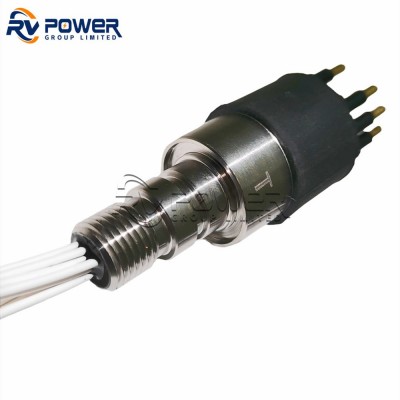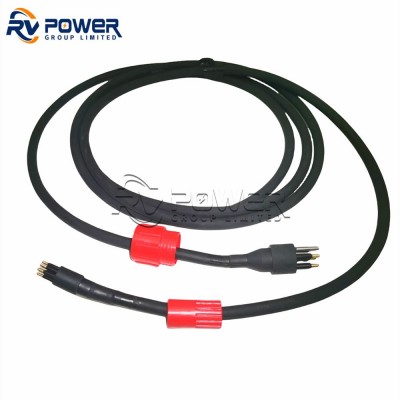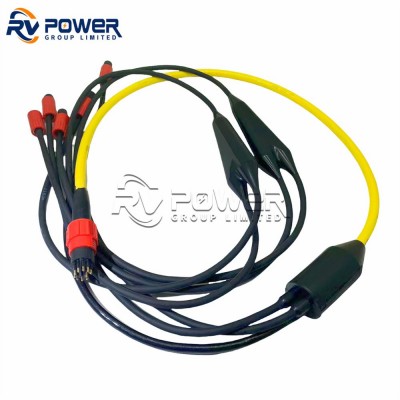
RV Power Group has successfully completed 3,000 m depth-rated sea trials on its next-generation 12-core hybrid opto-electrical wet-mate connector — combining 8 electrical contacts and 4 single-mode fiber optic channels in a single compact circular interface. This milestone represents a significant step forward for subsea interconnect technology, enabling ROV tether terminations, deep-ocean observatory nodes, and subsea Ethernet infrastructure to consolidate what previously required multiple connectors into a single, reliable wet-mate interface.
Standard copper-conductor Ethernet (1000BASE-T) has a maximum cable run of 100 metres. For ROV systems with umbilicals of 500 m to 4,000 m, copper-only Ethernet is simply not viable. The solution has always been to run fiber optic cable for the data channels — but this traditionally required a separate fiber optic connector alongside the copper power connector, adding penetrations, complexity, and potential leak paths to every interface.
Combining electrical and optical channels in a single connector body reduces the number of hull penetrations on a subsea instrument or ROV termination unit by up to 50%. Each penetration eliminated removes an O-ring surface, a potential leak path, and a maintenance point. For long-deployment oceanographic infrastructure, this is not a marginal improvement — it is a significant reliability gain.
| Parameter | Specification |
|---|---|
| Total channels | 12 (8 electrical + 4 optical) |
| Electrical contacts | 8 × gold-plated copper, rated 10 A / 300 V each |
| Optical channels | 4 × single-mode (OS2), LC-compatible ferrule, IL <0.5 dB |
| Optical wavelength | 1310 nm / 1550 nm compatible |
| Depth rating | 3,000 m (300 bar) — sea trial verified |
| Design rating | 4,000 m (400 bar) |
| Body material | 316L stainless steel |
| Sealing | Double O-ring face seal, EPDM |
| Coupling | Threaded locking ring with anti-rotation key |
| Operating temperature | -40°C to +85°C |
| Optical alignment | Precision glass ferrule with spring-loaded alignment sleeve |
| Mating cycles | >500 wet-mate cycles with IL change <0.1 dB |
Trials were conducted using a research vessel operating in the South China Sea, deploying a weighted test frame via winch to 3,050 m depth. The connector was mated on the surface, deployed to depth, held at pressure for 72 hours, and then recovered for post-trial inspection.
During the 72-hour deep-water hold period, an OTDR (Optical Time Domain Reflectometer) continuously monitored all 4 fiber channels at the surface end of the cable, logging insertion loss, return loss, and backscatter trace every 10 minutes. Electrical channels were monitored for insulation resistance and continuity via a dedicated subsea data logger.
| Test Parameter | Requirement | Result |
|---|---|---|
| Electrical insulation resistance | >500 MΩ at 72 hrs, 300 bar | 1,200 MΩ (all 8 contacts) |
| Optical insertion loss | <0.5 dB at depth | 0.28–0.34 dB (4 channels) |
| Optical IL change vs. surface | <0.1 dB | 0.03–0.06 dB |
| Post-recovery visual inspection | No water ingress to mating face | Pass — mating face dry |
| Post-recovery mating cycle test | IL <0.5 dB after 10 mates | 0.31–0.37 dB (all channels) |
All parameters passed with significant margin. The optical channels in particular demonstrated exceptional stability — insertion loss variation between surface and 3,000 m depth was less than 0.06 dB across all four channels, confirming that the ferrule alignment system maintains positional accuracy under hydrostatic load.
The principal engineering challenge in a wet-mate fiber optic connector is maintaining ferrule alignment under hydrostatic pressure. Our design uses a spring-loaded ceramic ferrule pair with a precision-ground alignment sleeve. The ferrule spring force is calibrated to maintain contact pressure under the full hydrostatic load at 4,000 m depth, preventing the slight axial displacement that causes insertion loss increase in non-compensated designs.
Unlike oil-filled optical connectors, our design uses a seawater-flush optical interface at the mating face. The ferrule end-faces are polished and the alignment geometry ensures that upon mating, any particulate contamination is displaced radially rather than trapped between the ferrule faces. This eliminates the catastrophic insertion loss events caused by particulate contamination in ferrule-to-ferrule contact.
The insulator incorporates a polyurethane matrix for the electrical contact zones and a precision-machined PEEK ferrule holder for the optical channels. This combination provides the casting flexibility needed for the complex electrical contact geometry while meeting the dimensional tolerances required for SM fiber alignment (<1 µm radial ferrule offset).
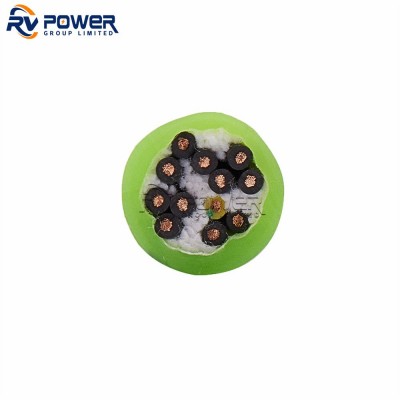
Work-class ROV tethers already carry both copper power conductors and fiber optic elements. The 12-core hybrid connector enables a single-connector termination at both the vehicle end and the tether management system end, eliminating the current practice of using separate power and fiber connectors side-by-side.
Cabled ocean observatories (such as NEPTUNE Canada, EMSO, and similar infrastructure) use subsea junction boxes that distribute power and fiber optic data to distributed instrument packages. The hybrid connector enables a standardised, single-connector instrument interface across the entire network.
Multibeam sonar systems, sub-bottom profilers, and laser bathymetry instruments that generate high data volumes requiring fiber optic transmission benefit from hybrid connectors that handle both the high-current sonar transducer power and the gigabit fiber optic data output in a single interface.
The 12-core hybrid connector is available for order now. Standard lead time is 4 weeks for quantities up to 10 units. Volume orders and OEM supply agreements for 50+ units per year are available on request. Engineering consultation for integration into new vehicle or instrument designs is provided at no charge.