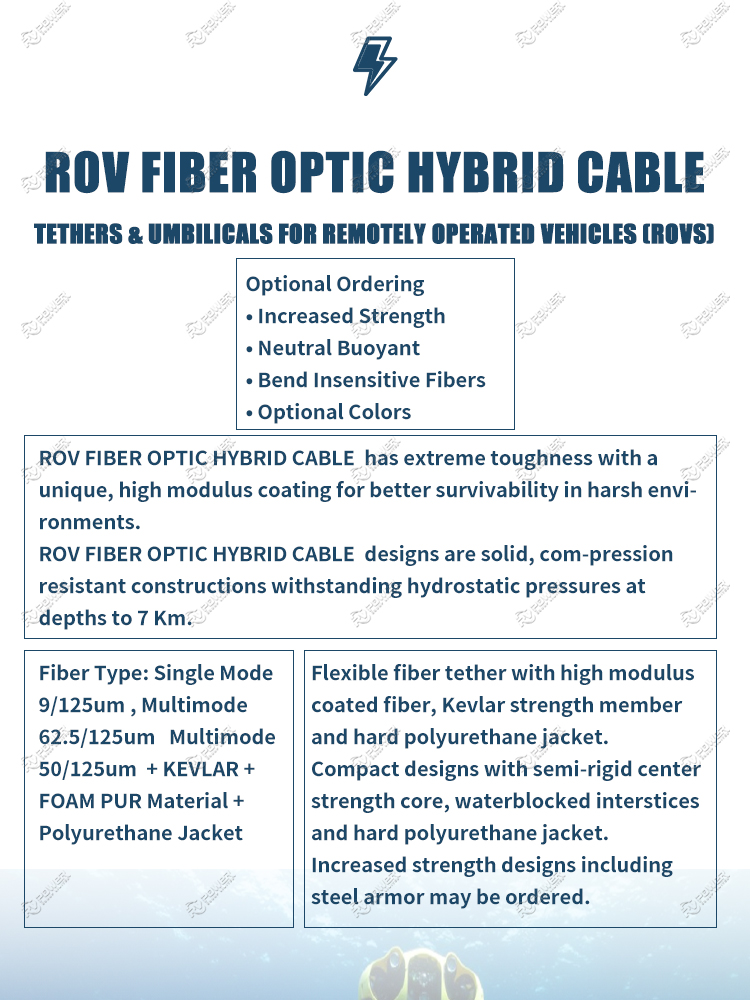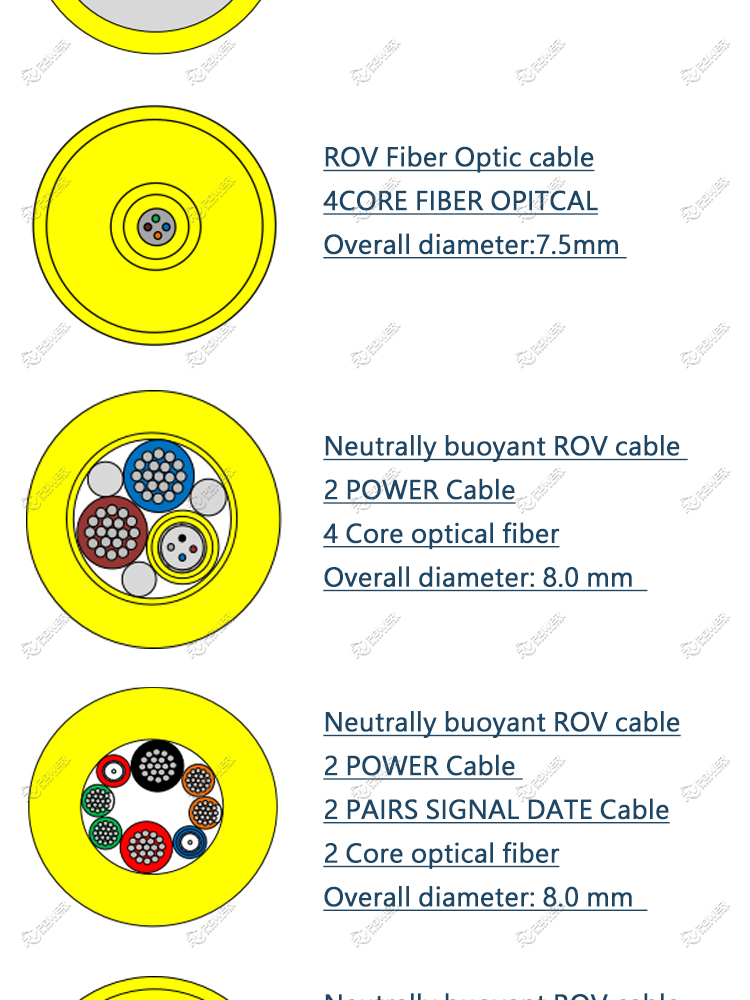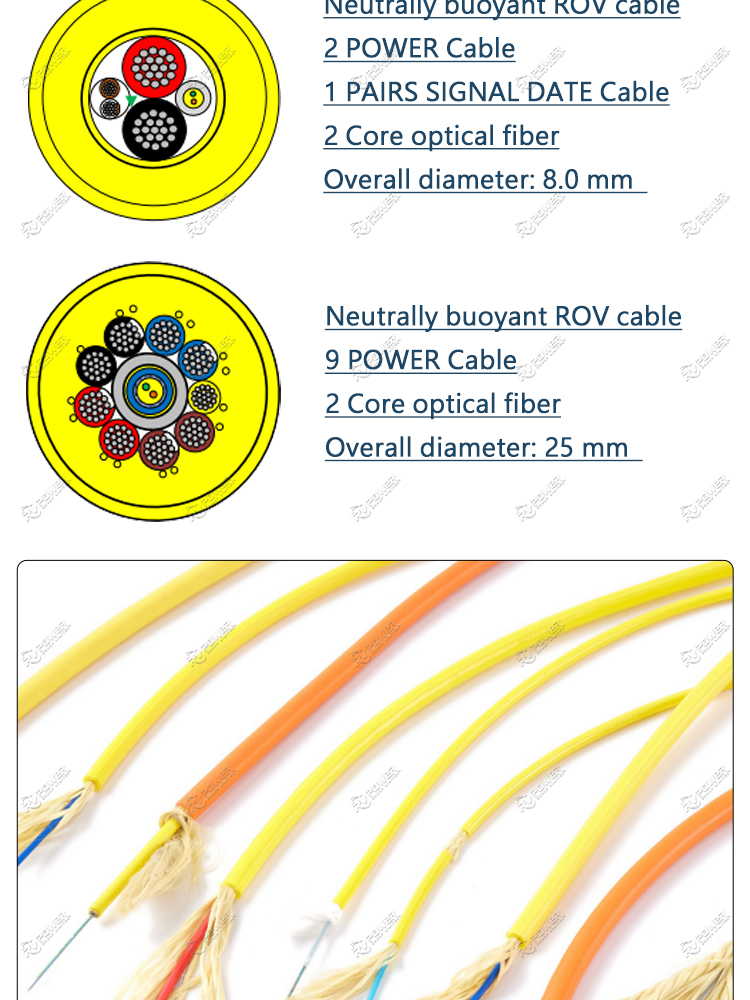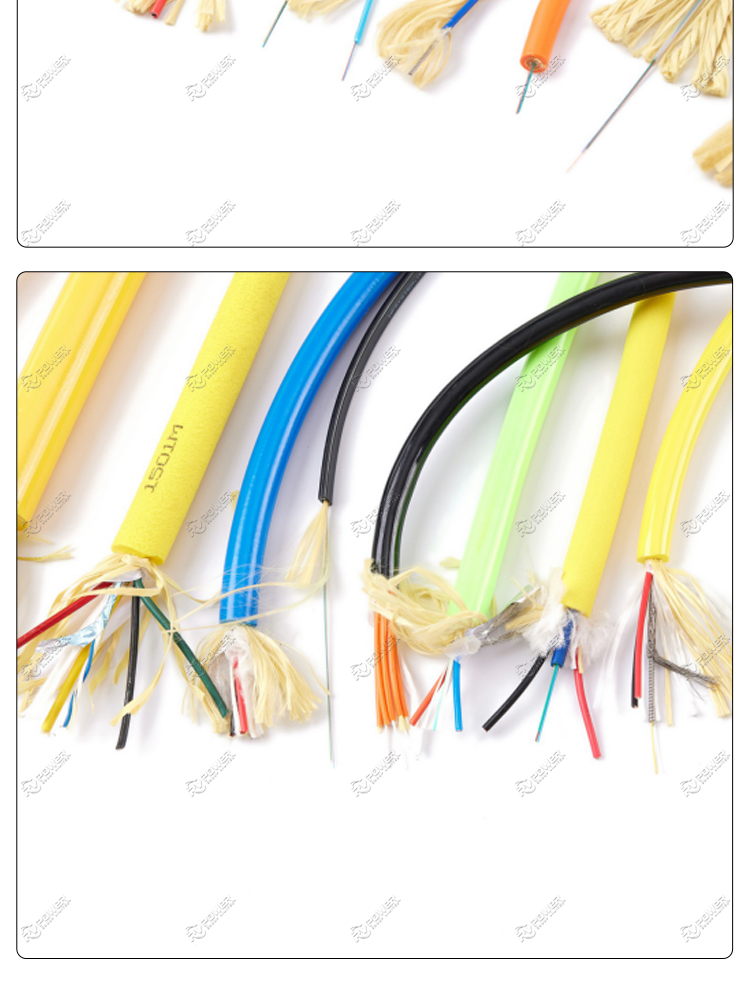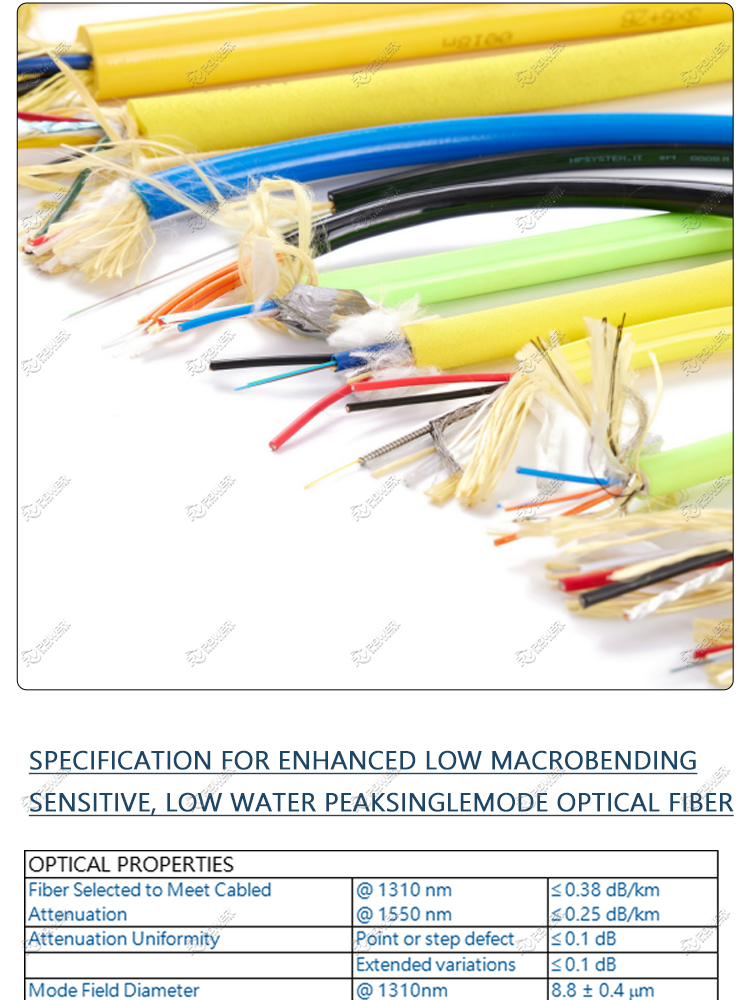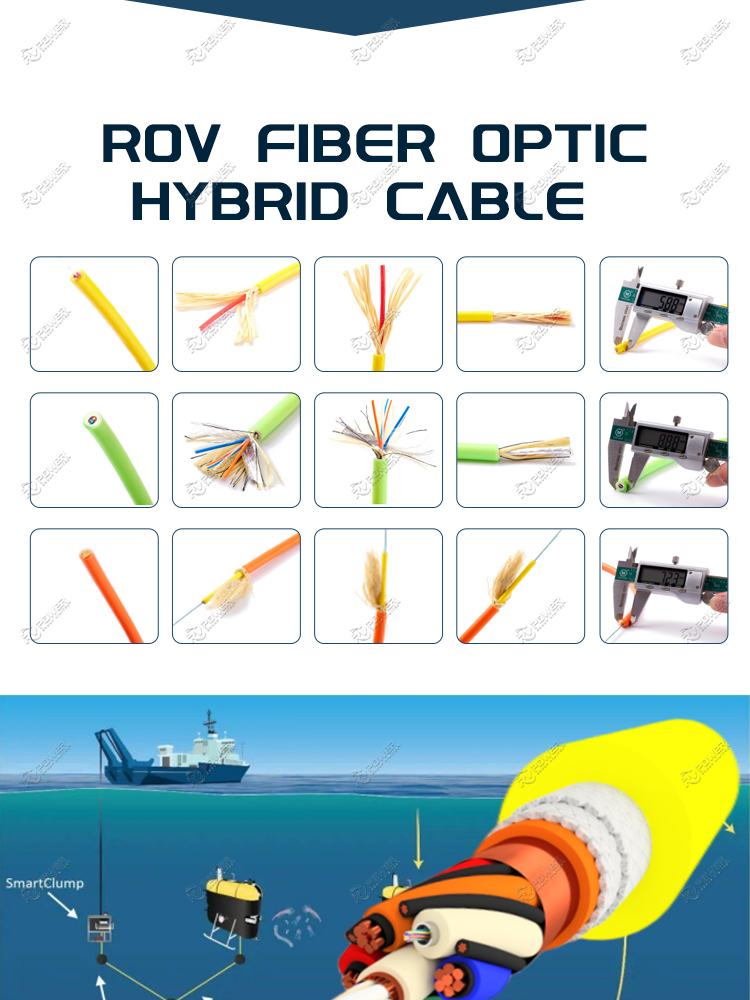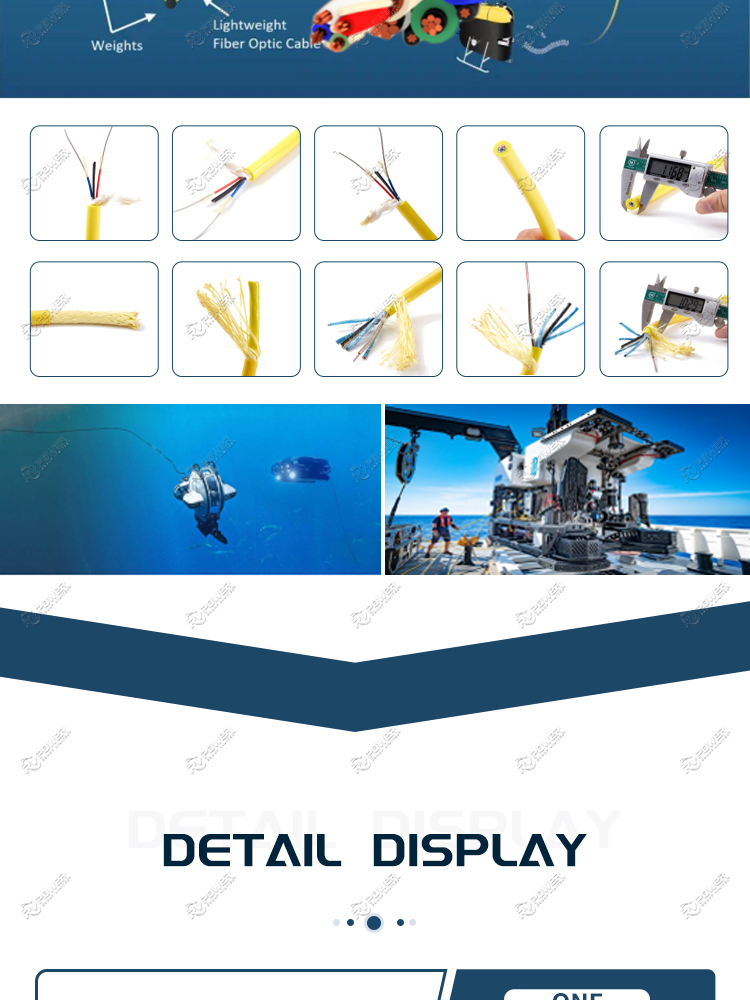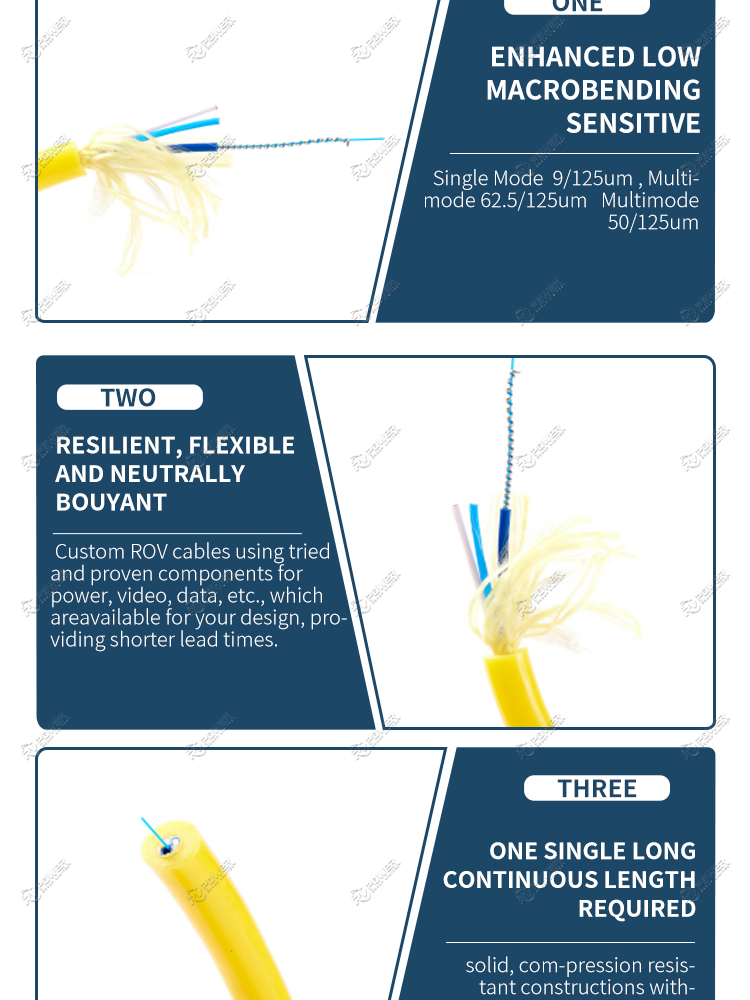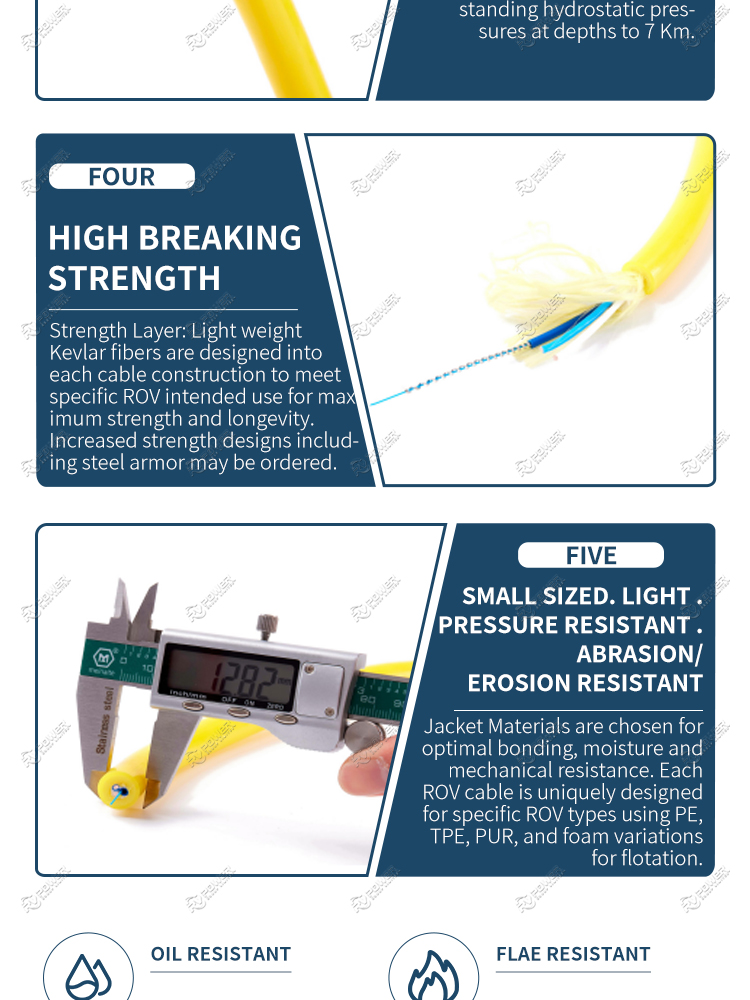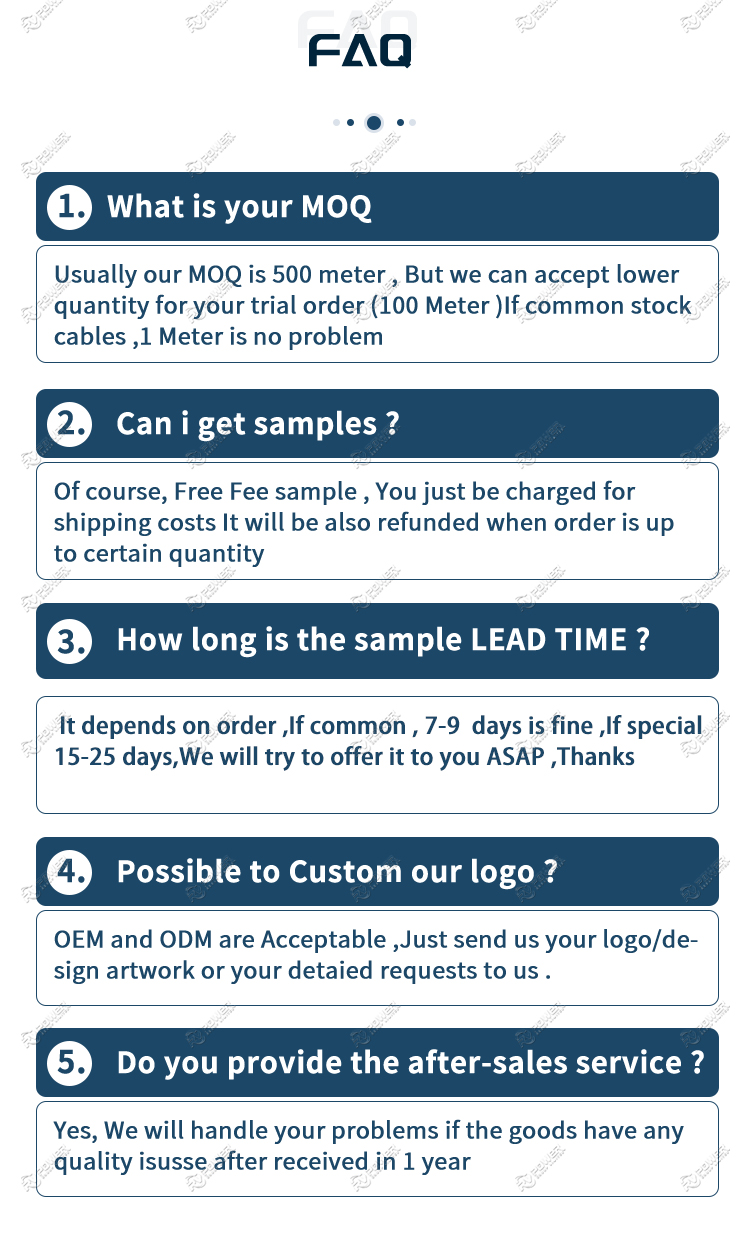

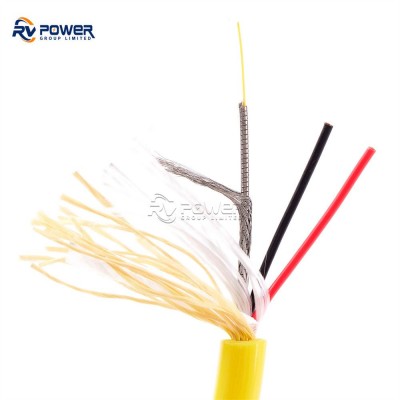
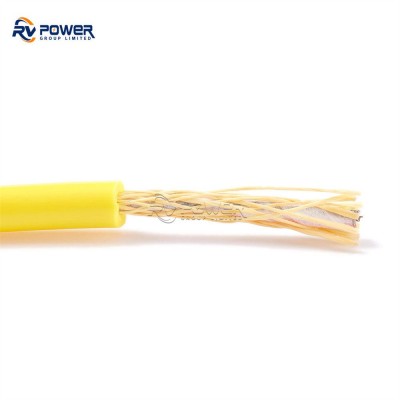
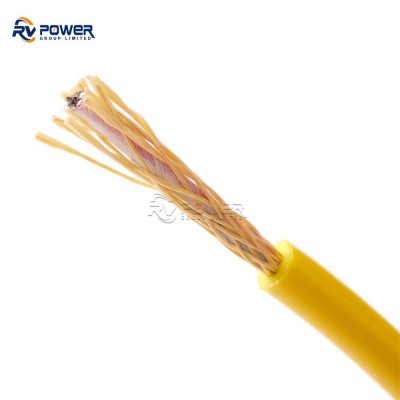
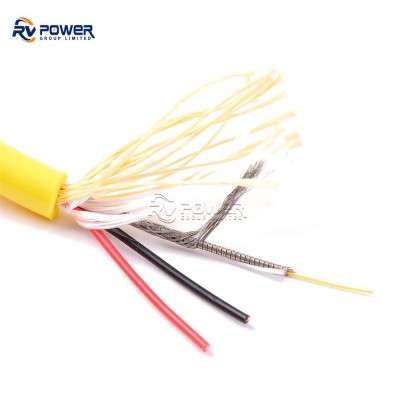
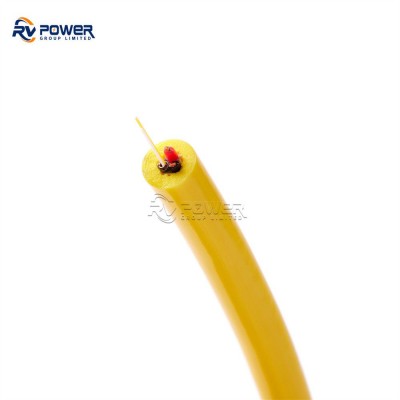
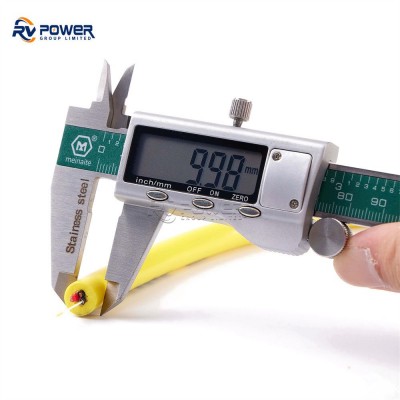
MULTICORE SINGLE-MODE FIBRE OPTIC + POWER HYBRID ROV Tether Floating Cable — ROV electro-optical hybrid tether combining single-mode or multimode fibre optic elements with power conductors in one Kevlar-reinforced cable. 3.6kV–600V power, 2,700–4,000 lbs break strength, rated to 7,000m. For work-class ROV, deep-sea survey, and scientific AUV systems.
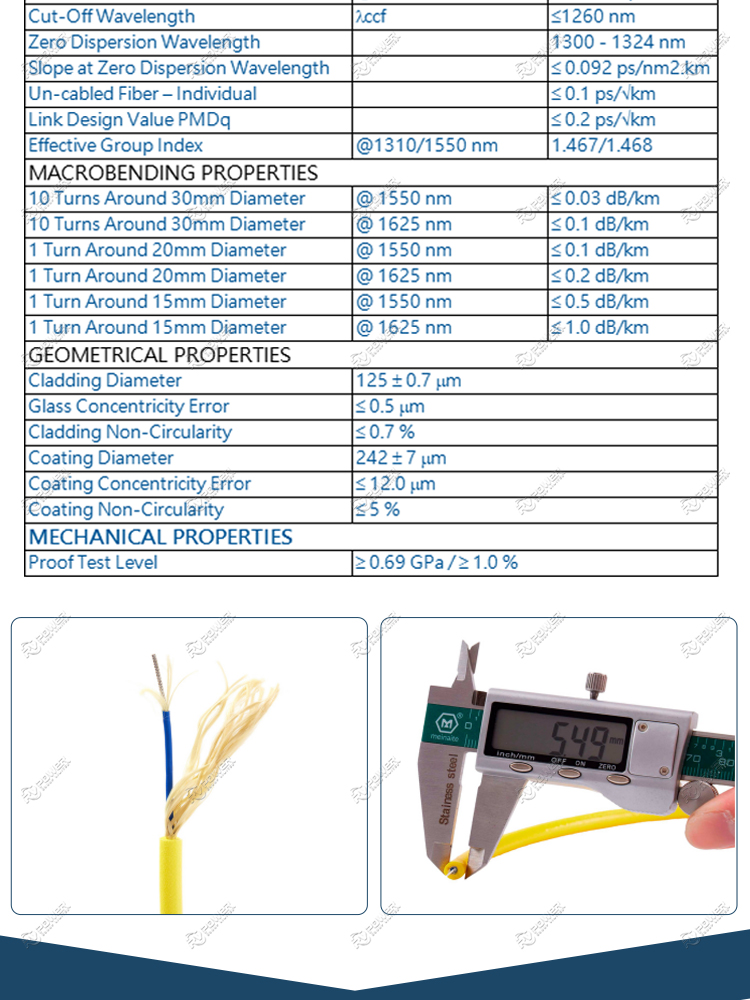
This MULTICORE SINGLE-MODE FIBRE OPTIC + POWER HYBRID ROV Tether Floating Cable is a precision ROV electro-optical (EO) hybrid cable that combines optical fibre elements with electrical power conductors in a single torque-balanced, Kevlar-reinforced jacket. While Ethernet tethers are limited by copper pair attenuation to a few hundred metres, fibre optic tethers transmit full 10 Gbps Gigabit and beyond at any depth — from shallow 100 m inspection dives to 7,000 m full-ocean ROV and AUV operations — with zero signal attenuation increase over increasing tether length.
Single-mode (SM) fibre provides long-distance, ultra-high-bandwidth data transmission for work-class ROV operations. Multimode (MM) fibre supports shorter-range high-bandwidth connections for vehicle-internal and TMS-to-vehicle tether segments. The power element — rated 600V to 3.6 kV — delivers propulsion power, lighting, and payload systems with the current capacity required for heavy-lift and deep-water intervention-class vehicles.
| Parameter | Observation EO | Light Work-Class | Deep Work-Class |
|---|---|---|---|
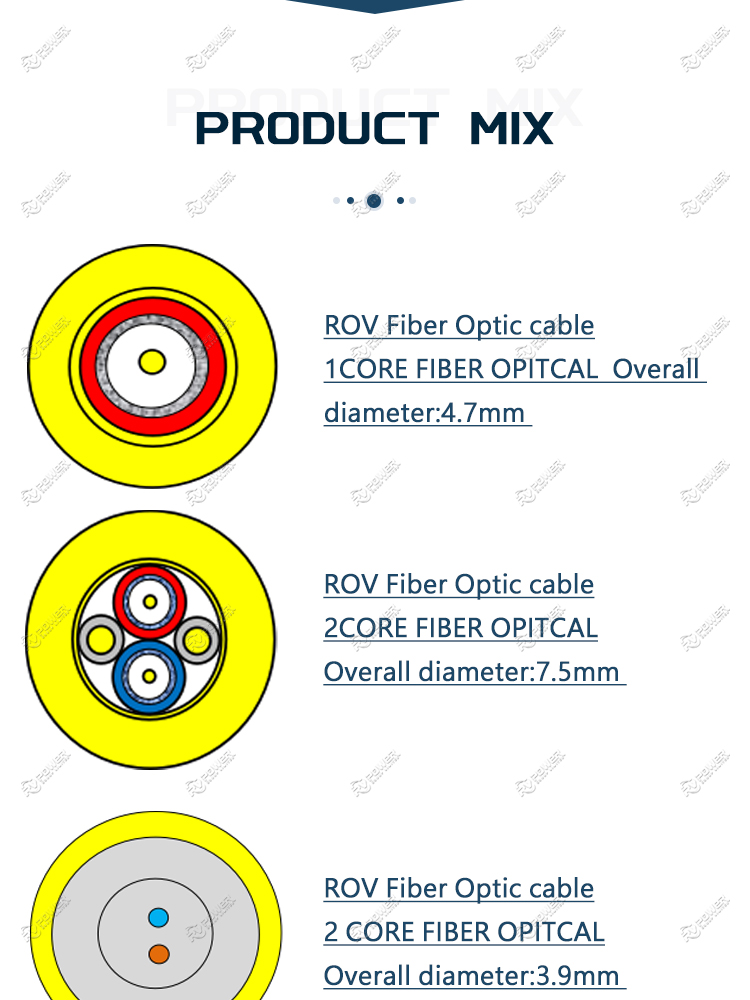
| Fibre Type | 1–2× SM G.652D | 2–4× SM G.652D | 4–8× SM G.652D + MM option |
| Fibre Housing | Simplex buffer tube | SS loose tube | SS loose tube, dual layer |
| Data Rate | 1–10 Gbps | 10–100 Gbps | 100 Gbps (DWDM capable) |
| Power Voltage | 600V | 1,000V | 3.6kV |
| Power AWG | 14–12AWG | 12–8AWG | 6–4AWG |
| Break Strength | 1,200–2,000 kg | 2,000–3,000 kg | 3,000–4,500 kg |
| Depth Rating | 300–1,000 m | 1,000–3,000 m | 3,000–7,000 m |
| OD Range | 12–20 mm | 20–30 mm | 30–50 mm |
| Jacket | Foam PUR | Dense PUR | PE or armoured |
| Temperature | -25°C to +85°C | -25°C to +85°C | -25°C to +85°C |
Copper twisted pairs (Cat6) have an attenuation of approximately 2 dB per 100 m at 100 MHz. At 300 m tether length, attenuation is 6 dB — the Gigabit Ethernet margin is consumed. At 500 m, 100BASE-TX (Fast Ethernet) becomes unreliable. At 1,000 m, any reliable Ethernet is impossible on copper. Single-mode fibre has attenuation of 0.2 dB per km at 1550 nm — enabling 10 Gbps at 7,000 m with complete eye margin to spare. For any ROV operating below 300 m, fibre optic is not a luxury; it is the only viable high-bandwidth tether medium.
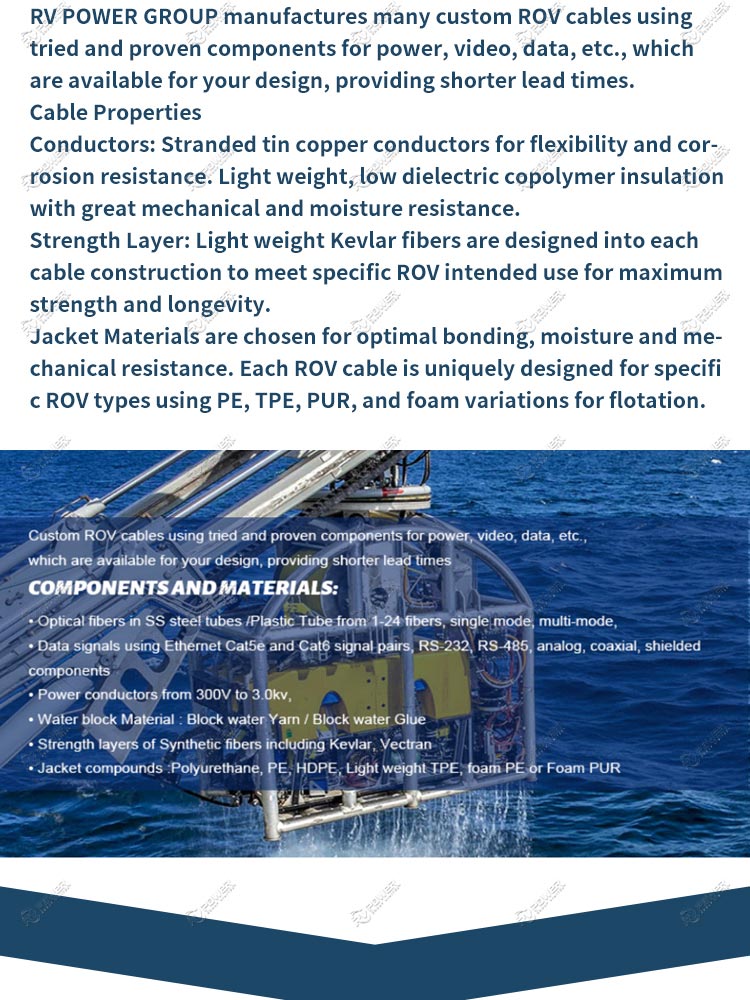
Optical fibres are mechanically strong in tension but catastrophically sensitive to transverse pressure and point loading. Without a protective metal tube, hydrostatic pressure at 1,000 m (100 bar) is sufficient to deform the polymer primary coating, causing micro-bend losses that increase fibre attenuation. SS-tube loose-tube construction isolates the fibre from hydrostatic pressure, mechanical loading from cable bending, and hydrogen-induced darkening — maintaining rated optical performance throughout the cable service life at any depth.
Work-class ROVs require 40–150 kW of electrical power at vehicle depth. At 24 VDC, this requires 1,700–6,250 A of current — physically impossible over any practical tether length. At 3.6 kV, the same power requires only 11–42 A — achievable with standard 4–8 AWG copper conductors in a practical tether OD. High-voltage EO hybrids are the only architecture that delivers work-class power to deep vehicles; low-voltage copper hybrid architectures are fundamentally limited to observation-class power levels.
Kevlar (para-aramid) has a strain at break of approximately 2.4% — at 2,000 kg tension on a 500 m tether, the cable stretches approximately 12 m. This elongation absorbs shipboard heave energy (beneficial in rough seas) but introduces depth uncertainty at vehicle level. Vectran liquid-crystal polymer has a strain at break of approximately 0.8% — three times less elongation than Kevlar — providing more precise depth positioning for scientific instrument deployments and pipeline survey operations requiring accurate depth logging.
| Model | Fibre | Power | BS (kg) | Depth (m) | OD (mm) |
|---|---|---|---|---|---|
| Simplex SM + 2C | 1× SM G.652D | 2×14AWG 600V | 1,200 | 300 | 12–16 |
| Duplex SM + 2C power | 2× SM G.652D | 2–4×12AWG 600V | 1,500–2,000 | 1,000 | 16–22 |
| SS-tube duplex + HV | 2× SM SS-tube | 2×10AWG 1,000V | 2,000–3,000 | 3,000 | 22–30 |
| Work-class 3.6kV | 4× SM SS-tube | 4×6AWG 3.6kV | 3,000–4,500 | 3,000–7,000 | 30–50 |
| Multimode hybrid | 2× MM OM3 | 2–4×12AWG 600V | 1,200–2,000 | 300–1,000 | 16–22 |
| Vectran low-elongation | 2× SM SS-tube | 2×8AWG 1,000V | 2,000 | 1,000–3,000 | 20–28 |
| Floating EO hybrid | 2× SM | 2×14AWG 600V | 1,000 | 300 | 14–18 |
| Armoured deep EO | 4–8× SM SS-tube | 4×4AWG 3.6kV | 5,000+ | 5,000–7,000 | 40–60 |
Perform an optical time-domain reflectometer (OTDR) baseline measurement on all fibre elements before first deployment — record fibre length, end-to-end attenuation, and all connector reflectance values. Repeat OTDR after each deployment and compare to baseline. Any increase in splice reflectance (>0.2 dB) or attenuation increase (>0.5 dB over baseline) indicates a fibre damage event — typically at a sharp bend on a drum flange or at a connector — that must be localised (OTDR locates the fault position to within 1 m) and repaired before the next dive.
Subsea optical connectors (penetrators) are the most critical maintenance item on EO hybrid tethers. Clean connector ferrule faces with IEC 61300-3-35 grade cleaning tools before each mating. Inspect ferrule faces with a 200× fibre scope — any scratch in the core area causes partial or complete light loss. After cleaning, mate connectors with a single smooth push-and-click motion; do not rock or twist — the angled PC or APC ferrule must seat squarely for rated return loss performance.
EO hybrids carrying 600V to 3.6 kV power conductors require dedicated high-voltage safety procedures during handling. Lock-out the topside HV power unit before any electrical work on the tether. Verify absence of voltage at both tether ends with a calibrated high-voltage indicator before touching electrical terminations. Test insulation resistance (IR) of each HV conductor to earth at 2.5 kV DC with a calibrated megohmmeter after each deployment season — minimum 100 MΩ is the acceptance criterion; values below 1 MΩ indicate urgent jacket inspection and repair need.
Specify fibre count and type (SM/MM), power voltage (600V/1kV/3.6kV), break strength, operating depth, buoyancy, and armour requirement — we engineer the exact EO hybrid tether for your ROV, AUV, or deep-sea survey system.
SM fibre 10 Gbps | 600V to 3.6kV | Kevlar/Vectran 1,200–5,000 kg | Rated to 7,000 m