

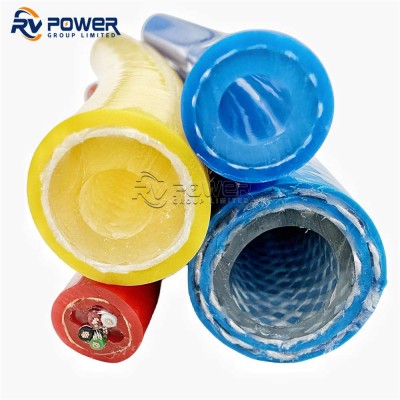
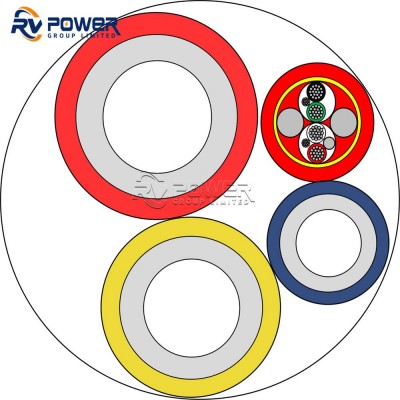
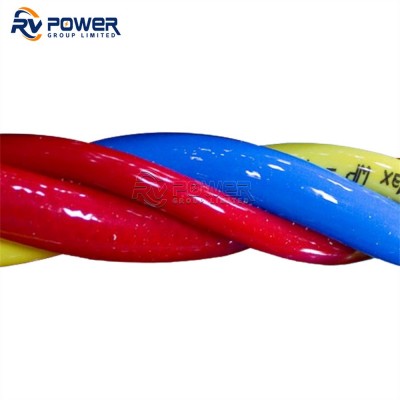
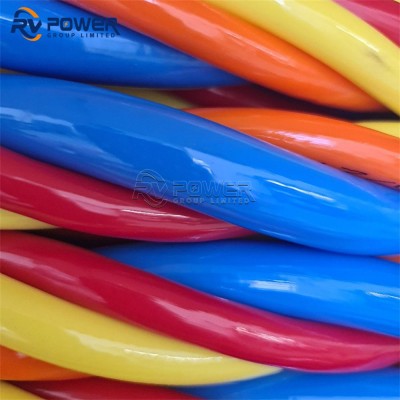
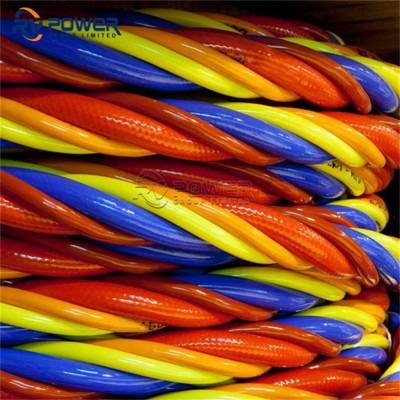
Diving Umbilicals (Air Pneumo Comms & Hot Water) — 4-Element Umbilical (Air + Pneumo + Comms + Hot Water) for surface-supply commercial diving. Twisted construction with gas supply hose, pneumo hose, communication cable, and hot water suit supply hose. Polyurethane hoses — no plasticisers, full breathing-gas compatibility. 4-wire universal communications, karabiner attachment, pressure tested and electrically verified. Compliant with IMCA D 023 / IMCA D 061. Available 50 m to 300 m, custom lengths on request.
This Diving Umbilicals (Air Pneumo Comms & Hot Water) is a professional-grade twisted commercial diving umbilical — the lifeline that connects a surface-supply diver to the dive control station on deck. Every commercial diver working under surface-supply procedures depends on their umbilical for breathing gas, depth monitoring, two-way voice communication, and emergency rescue — there is no backup if the umbilical fails at depth.
Manufactured as a twisted multi-element assembly, the umbilical integrates gas supply hose, pneumo hose, communication cable, and hot water suit supply hose into a single, manageable bundle with the inherent rope-like strength and kink resistance of a twisted construction. Unlike parallel-lay or bundled umbilicals, the helical twist distributes tensile load equally across all elements — so the umbilical can safely lift a fully-equipped diver in an emergency without a separate safety line.
| Element | Size / Conductor | Jacket Material | Function |
|---|---|---|---|
| Gas Supply Hose | 1/2" ID | Polyurethane (PU) | Breathing-grade, IMCA D 023 |
| Pneumo Hose | 3/8" ID | Polyurethane (PU) | Diver depth reference |
| Communication Cable | 4×20 AWG TC | PU jacketed | 4-wire comms |
| Hot Water Hose | 1/2" ID | PU (hi-temp rated) | Diver suit heater supply |
| Configuration | Gas Hose | Pneumo Hose | Comms Cable | Mini TV Coax | Hot Water Hose | Typical Use |
|---|---|---|---|---|---|---|
| 3-Part Standard | ✓ | ✓ | ✓ | — | — | Routine inspection, survey |
| 4-Part (+ Mini TV) | ✓ | ✓ | ✓ | ✓ | — | Offshore construction, IRM |
| 4-Part (+ Hot Water) | ✓ | ✓ | ✓ | — | ✓ | Cold water, North Sea, Arctic |
| 5-Element Full | ✓ | ✓ | ✓ | ✓ | ✓ | Saturation excursion, full IRM |
| Parameter | Specification |
|---|---|
| Construction | Helical twisted multi-element (rope-lay) |
| Hose Material | Polyurethane (PU) — no plasticisers, breathing-compatible |
| Gas Hose Working Pressure | 25 bar (362 psi) MWP / 600 psig factory test |
| Pneumo Hose Working Pressure | 25 bar (362 psi) MWP |
| Hydrostatic Test Pressure | 600 psig (41.4 bar) / 10 minutes — zero loss |
| Comms Conductor | 4 × 20 AWG tinned stranded copper |
| Comms Modes | 2-wire simplex, 4-wire duplex, through-water mode |
| Temperature Range (PU hose) | -40°C to +60°C (-40°F to +140°F) |
| Standard Lengths | 50 m, 75 m, 100 m (ex-stock); custom to 300 m |
| Emergency Tensile Load | Rated to lift full diver + equipment weight |
| Diver-End Attachment | 100 mm screw-locking karabiner on whipped D-ring |
| Gas Compatibility | Air, nitrox, heliox, oxygen (confirm when ordering) |
| Standards | IMCA D 023, IMCA D 061 |
| Test Documentation | Hydrotest certificate + electrical test record supplied |
Rubber hoses for diving contain vulcanisation compounds, plasticisers, and processing additives that can out-gas into the breathing gas stream — particularly in warm water when the hose interior temperature rises. PVC hoses are even worse: the plasticisers that keep PVC flexible are volatile organic compounds (VOCs) that slowly migrate into gas flowing through the hose. Polyurethane is a clean, unfilled polymer: no plasticisers, no vulcanisation chemistry, no organic additives — the only thing in contact with the diver's breathing gas is the pure PU polymer wall. This makes PU the mandatory choice for breathing-quality gas supply in all modern professional diving standards, and why our umbilicals use PU throughout rather than the cheaper rubber or PVC alternatives.
Parallel-lay umbilicals — where hoses and cables run side-by-side in a flat or round bundle — kink when the umbilical passes over a sheave, through a moonpool slot, or around a structure corner with a tight radius. A kinked gas hose can restrict breathing air supply below the demand regulator minimum flow rate — a potentially fatal event for the diver. The helical twisted construction distributes the bending stress around the twist circumference; no individual element ever reaches the kink radius, regardless of the overall umbilical bending angle. Additionally, the twisted structure is inherently strong in tension — the rope-lay geometry means all elements share the tensile load equally, giving the umbilical the structural capability to lift the diver in a man-overboard emergency without requiring a separate lifeline alongside the umbilical.
Two-wire communications systems restrict the diving operation to a single comms mode — either the surface unit or the diver's mask/helmet communications must be rewired if the other unit is changed. The 4-wire standard used in our umbilicals provides four separate conductors at the diver end; rewiring the surface banana-plug terminations (a 30-second operation) switches between simplex, duplex, and 4-wire modes — covering every commercially-available surface-supply diving radio and helmet communications system without any modification to the umbilical or diver-end connector. This matters on vessels that carry divers from multiple contractors using different communications equipment.
Many diving contractors, oil company asset owners, and government diving authorities require umbilicals to be supplied with documented test evidence — not just a supplier declaration. Every umbilical we supply includes a hydrotest certificate showing: test pressure (600 psig), test duration (10 minutes), test result (pass/fail), and technician signature. The electrical test record shows continuity and insulation resistance for every conductor in the communications cable and coaxial element (if fitted). These documents are accepted by IMCA, DNV, and major oil company diving management systems as the required pre-service evidence for a new or repaired umbilical.
Before each diving shift, walk the full umbilical length and inspect the outer sheath for cuts, abrasions, bulges, or fitting slippage at hose end fittings. Check the karabiner — gate opens freely, screw sleeve tightens fully, no corrosion on the gate pivot. Connect the communications cable to the surface panel and diver helmet/mask and verify clear two-way voice in both simplex and duplex modes. Pressurise the gas hose to working pressure with the diver-end closed and check all fittings for leaks with soapy water — any fitting that shows bubbles must be re-made before the dive. Check the pneumo gauge reads correctly at surface (should read surface atmospheric pressure as baseline before the diver enters the water).
