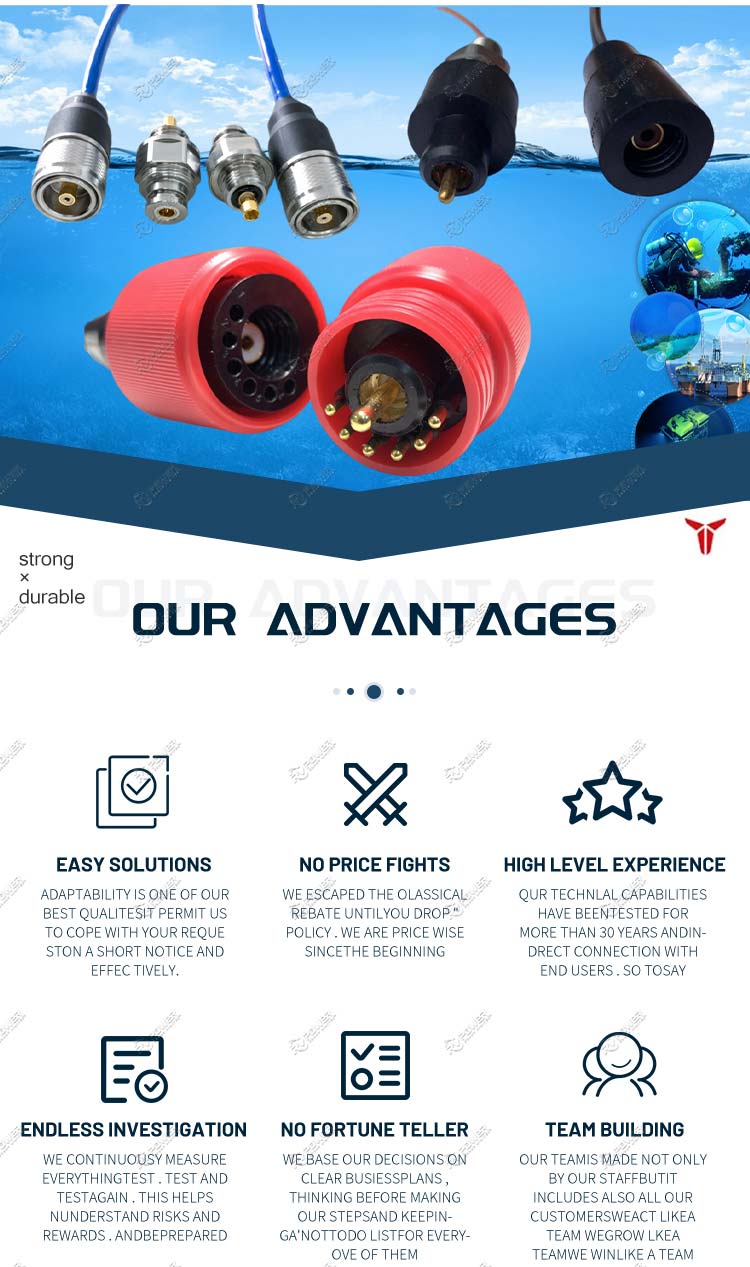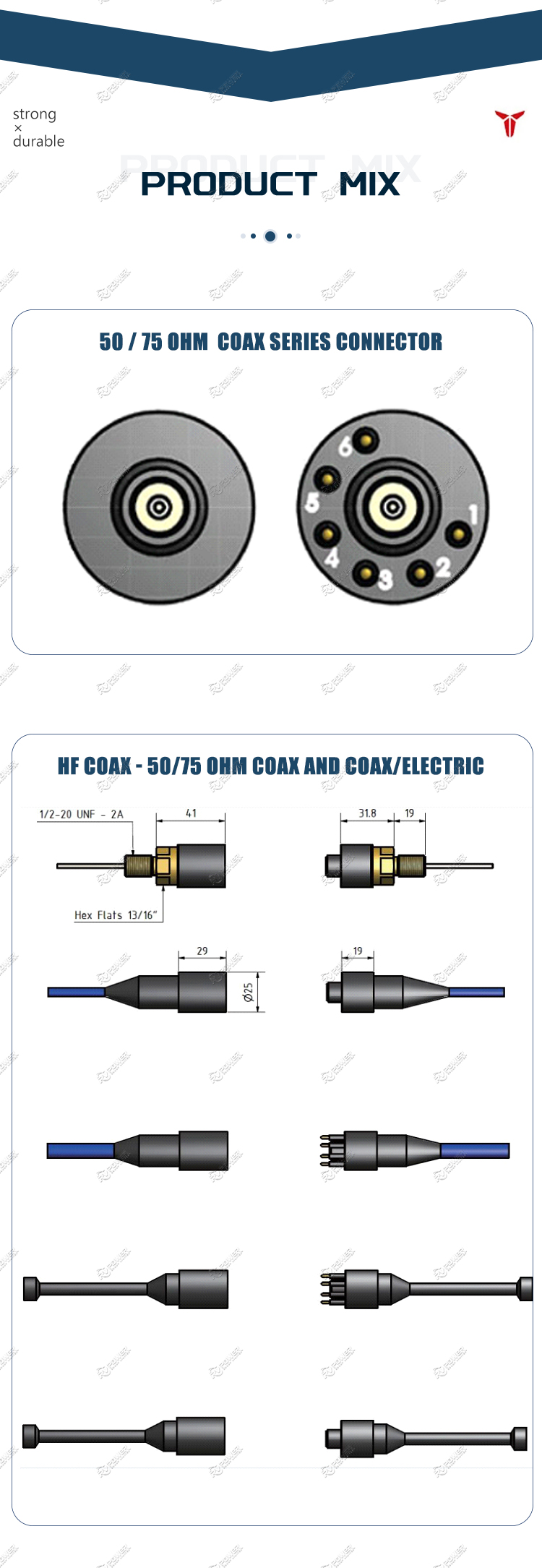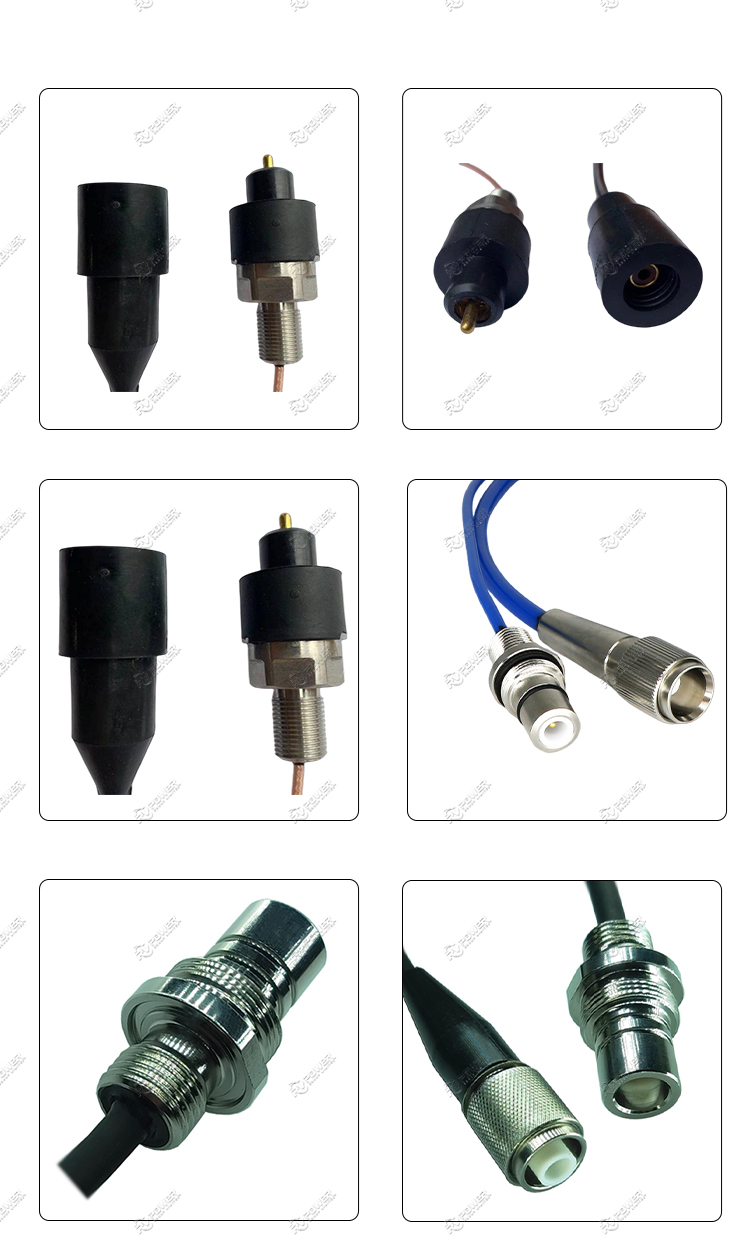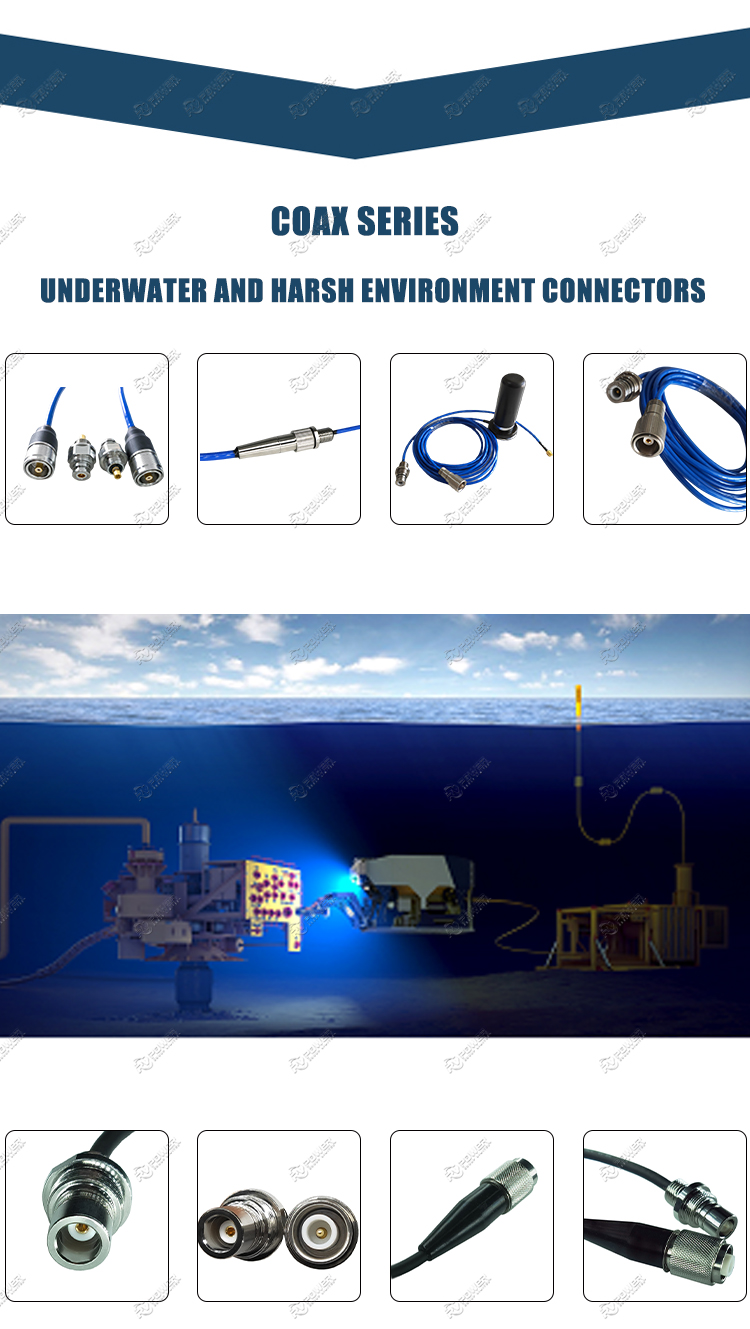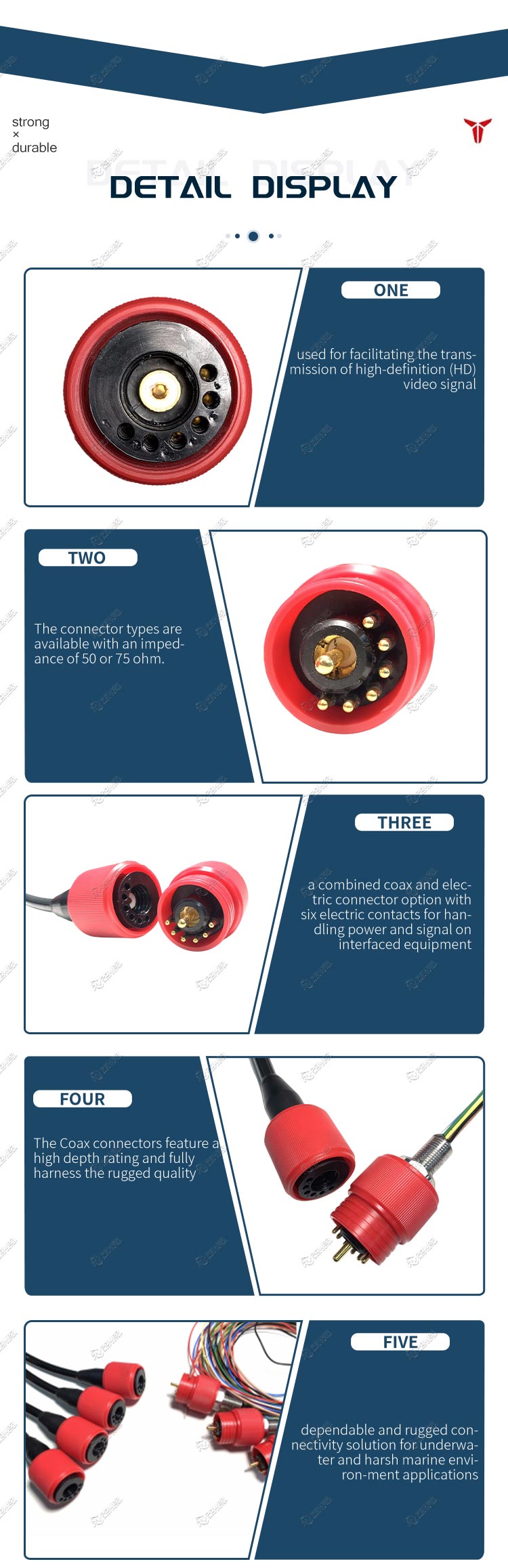

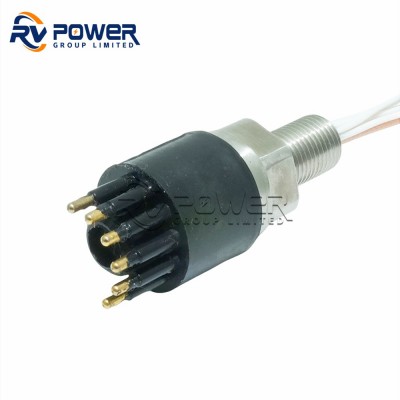
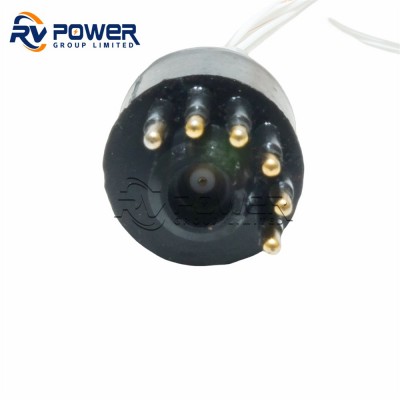
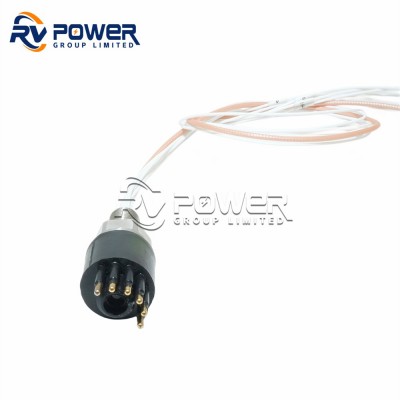
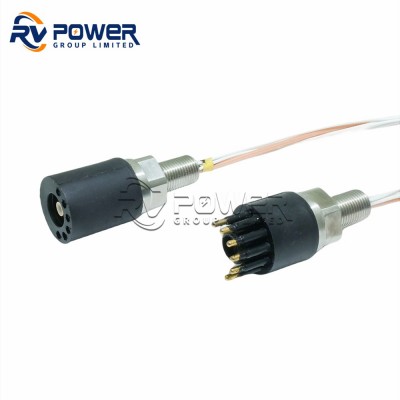
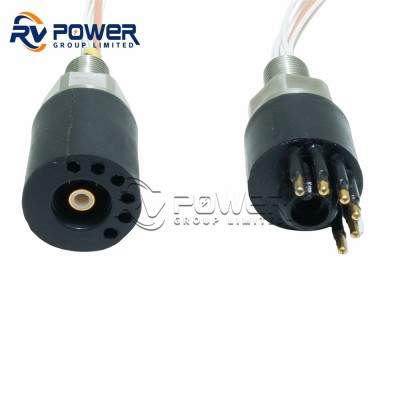
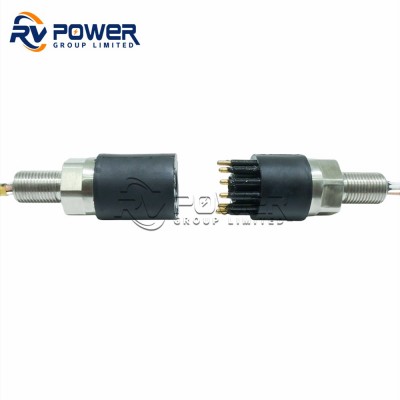
Precision-engineered 50 Ohm and 75 Ohm male bulkhead plugs for subsea coaxial connections. Rated to 3,000 meters (300 Bar) with vulcanized neoprene body and gold-plated contacts for zero-compromise RF signal integrity.
The 50CXBH6M (50 Ohm) and 75CXBH6M (75 Ohm) are the male plug counterparts in our HF Coax Bulkhead series — designed to mate with the female bulkhead receptacle (50CXBH6F / 75CXBH6F) permanently mounted in your ROV housing, junction box, or oceanographic instrument pod. Together, these connectors form a complete, impedance-matched RF signal pathway through the pressure hull of your subsea system.
If you are using legacy brand bulkhead connectors and facing 12–20 week lead times for a reorder, the 50CXBH6M and 75CXBH6M are your immediate solution. Dimensionally identical, electrically equivalent, and rated to 300 Bar / 3,000 meters — available in 1 to 2 weeks from order confirmation. Your offshore operations cannot afford to wait for a procurement cycle that should take days, not months.
[Request an Urgent Cross-Reference Quote] [Download STEP Files & Datasheet (Free)]
In the topology of a subsea signal system, the bulkhead male plug is the connector that travels with the cable. It is the "field" side of the interface — plugging into the fixed bulkhead receptacle on the instrument housing, then being protected by a locking sleeve that secures the mated pair against the mechanical forces of ROV tether pull, acoustic vibration, and hydrostatic pressure differentials during descent and ascent.
The 50CXBH6M / 75CXBH6M is factory-terminated to your specified coaxial cable — RG-58 or RG-316 for 50Ω applications, Mini-RG-59 or RG-179 for 75Ω video applications — and the cable-to-connector transition is chemically vulcanized, not simply overmolded with a thermoplastic. This distinction is critical for long-term subsea deployments where thermal cycling, UV exposure during deck operations, and prolonged seawater immersion can degrade inferior cable termination methods over months of operation.
When a mated 50CXBH6M / 75CXBH6M pair descends to 3,000 meters, it experiences a compressive hydrostatic load of 4,351 PSI. This load acts equally in all directions on the connector body. Several physical mechanisms are simultaneously at work:
The most RF-critical region of any subsea coaxial connector is the 15–20mm transition zone between the coaxial cable's constant-impedance geometry and the connector's internal geometry. In this zone, if the ratio of inner conductor diameter to outer conductor diameter (which determines characteristic impedance) changes abruptly, a reflection will occur.
Our 50CXBH6M and 75CXBH6M use a tapered transition geometry with a controlled dielectric spacer profile, smoothly transitioning the electromagnetic fields from the cable's coaxial TEM mode into the connector's equivalent coaxial geometry. The result is a measured insertion loss below 0.4 dB at 1 GHz and VSWR below 1.3:1 up to 2 GHz — performance that is meaningfully superior to connector designs that use abrupt transitions in the cable termination zone.
| Parameter | 50CXBH6M (50 Ohm) | 75CXBH6M (75 Ohm) |
|---|---|---|
| Connector Type | Male Plug (Cable-End, Bulkhead-Mating) | Male Plug (Cable-End, Bulkhead-Mating) |
| Characteristic Impedance | 50 Ω (± 2Ω) | 75 Ω (± 3Ω) |
| Frequency Range | DC to 3.0 GHz | DC to 3.0 GHz |
| Insertion Loss | < 0.4 dB @ 1 GHz | < 0.4 dB @ 1 GHz |
| VSWR | < 1.3:1 up to 2 GHz | < 1.4:1 up to 2 GHz |
| Voltage Rating | 800 V DC | 600 V DC |
| Insulation Resistance | > 200 MΩ @ 500 VDC | > 200 MΩ @ 500 VDC |
| Depth Rating | 300 Bar / 3,000 m | 300 Bar / 3,000 m |
| Mating Type | Dry-Mate only | Dry-Mate only |
| Contact Material | Brass, deep Gold-Plated (ASTM B16) | Brass, deep Gold-Plated (ASTM B16) |
| Body Material | Vulcanized Chloroprene (Neoprene) | Vulcanized Chloroprene (Neoprene) |
| Compatible Cable (50Ω) | RG-58, RG-316, LMR-100 | — |
| Compatible Cable (75Ω) | — | Mini-RG-59, RG-179, RG-6 |
| Operating Temperature | -40°C to +80°C | -40°C to +80°C |
| Locking Sleeve | POM or 316L SS (mandatory) | POM or 316L SS (mandatory) |
| Mating Receptacle | 50CXBH6F Female Bulkhead | 75CXBH6F Female Bulkhead |
| Customization Available | Cable length, jacket material, housing alloy | Cable length, jacket material, housing alloy |
In a typical work-class ROV, the 75CXBH6M terminates the camera umbilical cable and mates with the 75CXBH6F receptacle mounted on the camera pressure housing. The male plug is often replaced more frequently than the bulkhead receptacle — because it is located in the "field" where cable handling, deck operations, and tether management cause mechanical wear. Our factory-replacement service provides a standard lead time of 5–7 business days for pre-terminated cable assemblies, ensuring camera systems return to operation quickly after cable damage events.
Acoustic modems require a 50Ω RF connection between the transducer and the modem electronics housing. The 50CXBH6M is the field-side plug that terminates the transducer feedline cable and connects to the modem pressure housing via a 50CXBH6F receptacle. The demanding RF environment of acoustic communications — wide frequency sweep, high peak voltages — makes the deep gold-plated contacts and precise 50Ω geometry of our male plug essential for reliable long-term operation.
Benthic landers deployed on the seafloor for 12-month science missions carry multiple instrument clusters — CTD sensors, current meters, sediment traps — each communicating over a coaxial harness back to the central data logger. The 50CXBH6M provides the instrument-side plug for these harness connections, with the vulcanized neoprene overmold ensuring that even after 12 months at 4,000m depth (with a 4:1 safety margin from our 3,000m rating), the connectors can be demated and remated on recovery without seal degradation.
Subsea control modules (SCMs) on tidal and wind turbine foundations often incorporate RF communication ports for condition monitoring data. The 50CXBH6M provides the cable-side termination for communication cables routed from the SCM to surface relay buoys or vessel-side transceivers, operating reliably in aggressive near-shore tidal environments.
Unmanned Underwater Vehicles (UUVs) used in mine countermeasures, hydrographic survey, and intelligence gathering missions require RF connector systems with low acoustic signature and minimal magnetic permeability. Our titanium housing variant of the 50CXBH6M satisfies both requirements — non-magnetic and acoustically neutral — while maintaining full electrical performance.
In the subsea industry, vessel day rates for offshore support vessels commonly exceed USD 50,000–150,000 per day. A single missing RF connector that delays a vessel departure represents a financial exposure that dwarfs the connector cost by three to four orders of magnitude. Yet many procurement managers continue to accept 12–20 week lead times as "normal" for subsea RF connectors — because for legacy manufacturers with aging infrastructure, it is.
Our manufacturing model is built around a different premise: every standard connector configuration should be available within 2 weeks, with emergency service available in 72 hours. We achieve this through:
Transitioning from a legacy supplier to a new connector manufacturer is a decision that engineering teams rightly approach with caution. System qualification is time-consuming, and a connector change that requires re-tooling pressure housing bore dimensions or updating wiring schematics can delay a project by months. Our 50CXBH6M / 75CXBH6M series was designed from the outset to eliminate these transition barriers.
For customers performing a formal qualification validation, we provide a free Cross-Reference Compatibility Report that maps our 50CXBH6M / 75CXBH6M against the specific legacy part numbers used in your system, confirming dimensional and electrical equivalency. Request this report through our engineering contact form.
A: Yes. Our 50CXBH6M uses the industry-standard coaxial bulkhead male plug geometry. It will mate correctly with any female receptacle that conforms to the same standard, regardless of brand. This makes it ideal for field replacement situations where only the cable-end plug needs to be replaced.
A: Yes. We offer both factory-terminated cable assemblies and bare connector bodies for customers who prefer to perform in-house cable termination or who have specialized cable requirements. The bare connector body includes the contact insert and all hardware but is supplied before overmolding. Contact our engineering team for bare connector pricing.
A: The locking sleeve is what transfers the mechanical load of the hydrostatic pressure from the mating interface to the threaded engagement system. Without the locking sleeve, the hydrostatic pressure can physically push the male plug out of the female receptacle at depths below approximately 50 meters. Always ensure the locking sleeve is fully engaged and at its positive stop before submerging. This is a universal requirement for all dry-mate subsea connectors of this type.
A: We offer optional third-party witnessed pressure testing at a certified hyperbaric testing facility. Test samples are subjected to 300 Bar water pressure for a minimum of 30 minutes, with insulation resistance measured before and after. Test certificates are provided with the shipment. This service is available at an additional charge and requires 1 additional week of lead time.
A: Yes. We have supported serial production volumes significantly larger than this for multiple ROV manufacturers and oceanographic equipment companies. For volumes above 50 units per order, we offer framework agreements with fixed pricing, reserved manufacturing capacity, and guaranteed lead times. Contact our sales team to discuss a supply agreement tailored to your program schedule.
The 50CXBH6M and 75CXBH6M are available now — no backorder, no extended lead time negotiation, no minimum order quantity on standard catalog items. Whether you need a single unit for an emergency repair, a batch of 50 for a vessel refit, or a framework agreement for a multi-year ROV program, our team is equipped to respond within 2 hours of your inquiry.
We understand that subsea connector procurement decisions are made under pressure — sometimes literally. Our application engineering team is available to provide rapid technical support, dimensional drawings, and qualification test data to help your team make the right decision quickly and with full confidence.